
The Future of Membership Isn’t Membership
There is a conversation quietly unfolding
across association boardrooms throughout
Australia and New Zealand.
It rarely begins with declining membership numbers or renewal rates. Instead, it starts with questions that are far more difficult to answer.
- Why are members engaging differently?
- Why are some communities thriving while others struggle to maintain momentum?
- Why do people happily invest their time in professional networks, online communities and industry events, yet hesitate when it comes to joining or renewing membership?
These questions often lead organisations towards tactics. They redesign benefits, adjust pricing, launch new events, build online communities or refresh their websites. While each of these initiatives can add value, they rarely address the deeper shift that is taking place.
The future of membership is not being shaped by better membership packages. It is being shaped by changing human expectations.
Across every sector, people are redefining what belonging means. They still seek trusted information, professional development, advocacy, recognition and meaningful relationships. What has changed is the way they expect those experiences to be delivered. Membership is no longer viewed as the destination. It has become one part of a much broader relationship with an organisation and its community.
For associations, this presents both a challenge and an opportunity. The organisations that recognise this shift early are likely to strengthen their relevance over the coming decade. Those that continue to treat membership as a transaction may discover that even excellent benefits are no longer enough to sustain long-term engagement.
People Still Want Community. They Simply Experience It Differently.
The desire to belong has not diminished. If anything, it has become more important.
Research from the Harvard Business Review has consistently shown that a sense of belonging contributes significantly to engagement, trust and organisational commitment, with employees and professionals who experience belonging demonstrating higher participation, stronger collaboration and greater loyalty.
Outside the workplace, similar patterns are emerging across professional communities. Individuals are increasingly building personalised networks that combine industry events, LinkedIn conversations, podcasts, webinars, mentoring relationships and informal peer groups. Rather than relying on one organisation to provide every answer, they are creating ecosystems of learning and connection that fit their own needs.
This does not diminish the role of associations. In many ways, it elevates it.
Associations have always existed to bring people together around a shared profession, industry or purpose. Their greatest strength has never been access to information alone. It has been their ability to convene conversations, establish trusted standards, advocate on behalf of members and create communities built on common goals.
What is changing is that these strengths can no longer sit quietly behind an annual membership invoice. They need to be experienced consistently throughout the member journey.
“Membership is no longer the product. The relationship is.”
The Organisations Winning Attention Are Creating Participation
Many organisations continue to measure success through outputs. They count newsletters sent, events delivered, webinars hosted, policy submissions completed and resources published. These measures remain important because they demonstrate activity and accountability.
Members, however, tend to judge value differently.
They remember the conversation that solved a difficult problem. They remember the introduction that led to a new opportunity. They remember feeling welcomed at an event, hearing someone articulate a challenge they had been struggling to explain or discovering practical ideas that immediately improved their work.
These moments are difficult to quantify, yet they often determine whether someone feels connected to an organisation.
McKinsey & Company has argued that communities create value through participation rather than passive consumption, describing successful communities as environments where members actively contribute, interact and build relationships instead of simply receiving content.
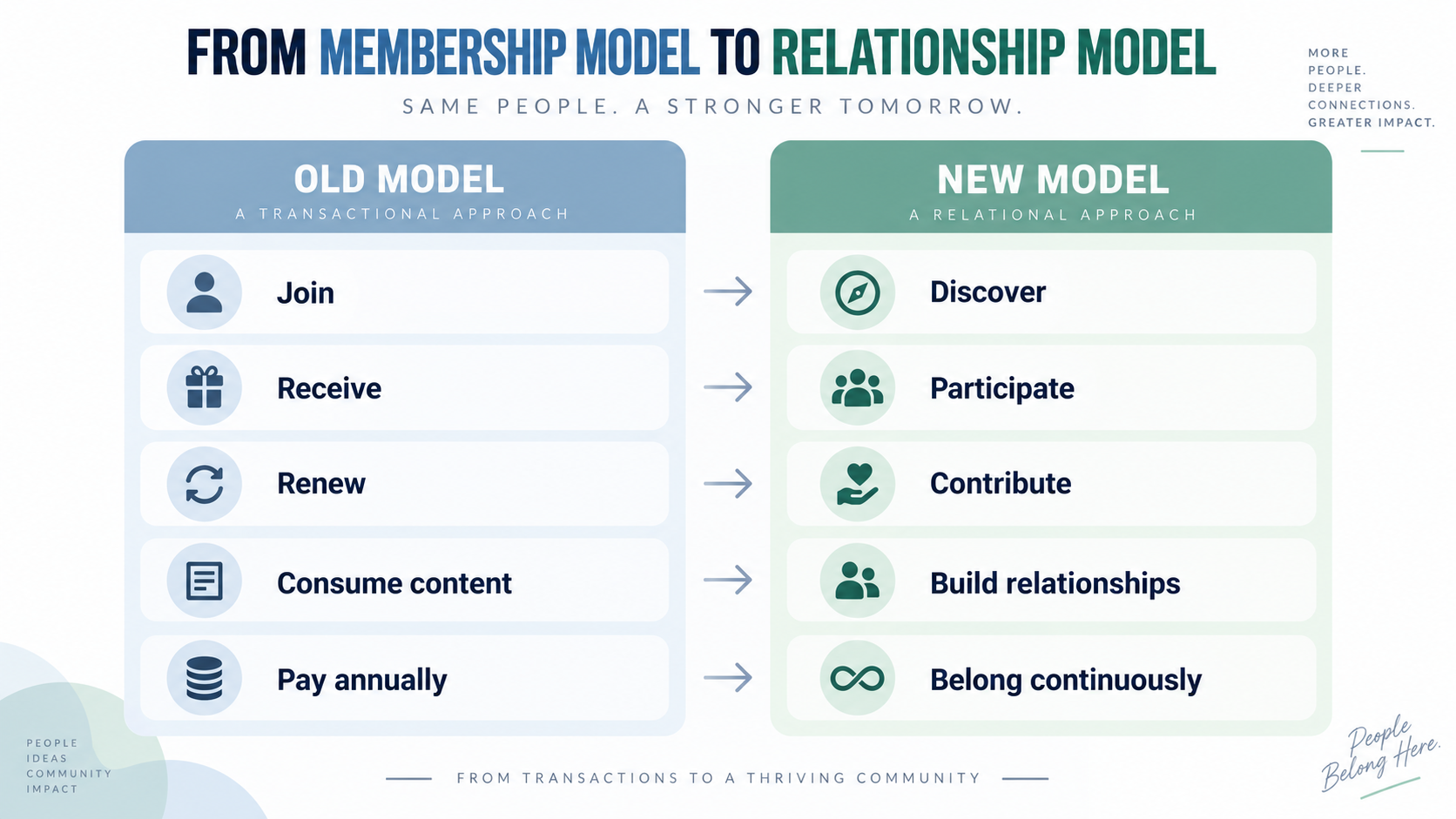
For associations, this represents an important mindset shift. Members should not simply consume the organisation. They should increasingly shape it.
When members contribute ideas, mentor emerging professionals, participate in discussions, volunteer, present at events or share their own experiences, they begin investing more than money. They invest identity, knowledge and time. That investment is significantly harder to replace than a discount or additional member benefit.
Renewal Is the Outcome, Not the Objective
Renewal campaigns often become the focal point of membership strategies.
Emails are scheduled, benefits are highlighted and reminders are carefully timed. While these activities remain essential, they are not where renewal decisions are made.
Renewal is simply the final expression of an experience that has unfolded across twelve months.
Marketing General’s most recent Membership Marketing Benchmarking Report found that associations with stronger engagement throughout the year consistently achieve higher renewal outcomes than organisations relying primarily on renewal campaigns and benefit communication
That finding should not surprise association professionals.
Members who have attended events, participated in discussions, developed relationships, learned something new and felt represented by their association rarely evaluate renewal solely through financial value. Their decision is shaped by whether they still see themselves as part of the community.
This changes the question associations should be asking.
Instead of asking, “How do we improve renewal?”
A more valuable question becomes, “How do we create meaningful moments every month that reinforce why someone belongs here?”
The answer is rarely found in one major initiative. More often, it is found in dozens of small, intentional experiences that accumulate over time.
Membership Is Becoming a Journey Rather Than a Category
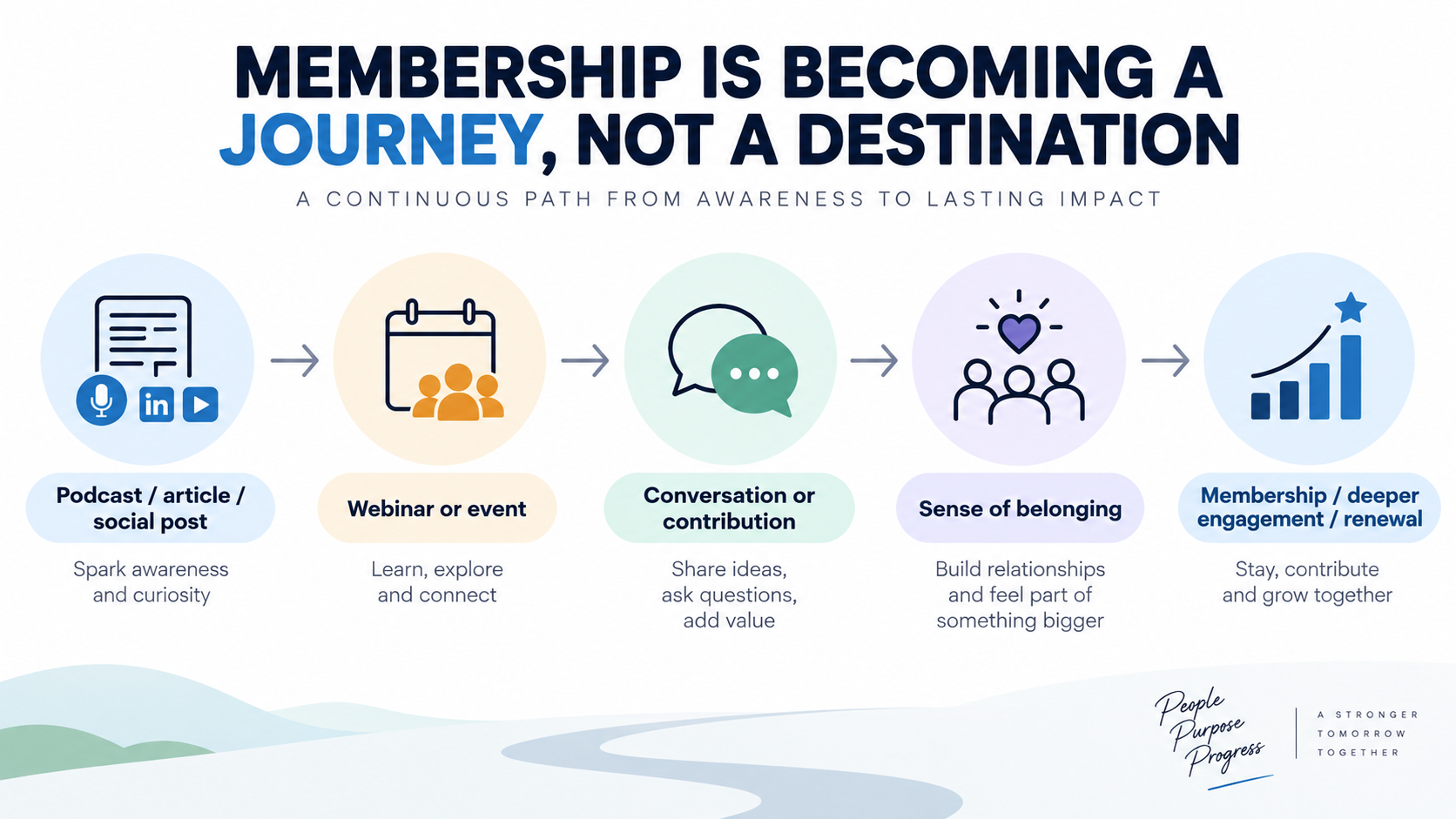
Traditional membership models often assumed a relatively linear pathway. A prospective member discovered the association, joined, attended events, renewed annually and perhaps volunteered later in their career.
Today’s journey is far less predictable.
Someone may first encounter an association through a podcast episode, a LinkedIn article, a webinar, a conference presentation or a recommendation from a colleague. They may participate in conversations for months before considering membership. They may attend public events before joining, contribute content before volunteering or engage digitally before ever meeting another member in person.
The path is no longer linear because people’s professional lives are no longer linear.
This requires associations to think beyond the membership application itself. Every interaction becomes part of the membership experience, whether or not someone currently holds a membership number.
Rather than asking how to move people into membership more quickly, associations may find greater success by asking how they can build trust more consistently.
Trust almost always precedes commitment.
Looking Ahead
The associations that flourish over the next decade are unlikely to be those with the largest list of benefits or the most sophisticated technology.
They will be the organisations that understand how community is changing.
They will continue to advocate, educate and convene, but they will also become facilitators of conversations, connectors of people and creators of experiences that members cannot easily replicate elsewhere.
Membership will remain important because it provides the framework that supports these activities. However, the value people experience will increasingly come from what happens between the transactions rather than because of them.
That is both the challenge and the opportunity facing every association today.
Practical Steps
As you reflect on your own association, consider these questions with your Board and executive team.
- Map every interaction a member has with your organisation across an entire year. Where do they genuinely feel connected, and where are they simply receiving information?
- Review your engagement measures. Are you primarily reporting activity, or are you measuring participation, relationships and contribution?
- Ask members why they remain involved, rather than only why they joined. The answers are often very different.
- Consider whether your marketing communicates benefits or whether it tells the story of belonging, community and professional growth.
- Identify one opportunity each month where members can actively contribute to the community rather than passively consume content.
Small improvements made consistently across the member journey often have a greater impact than one significant initiative launched at renewal time.
If your association is exploring how membership, community and engagement are evolving, we’d be pleased to continue the conversation. Every organisation’s context is different, and sometimes an external perspective or introduction to the right people can help clarify the next step.
If you need further support, reach out to the Answers for Associations team. If we can help, we will. If someone else is better placed to assist, we’ll happily point you in the right direction.
